Mastering An Overview of SOLID Principles
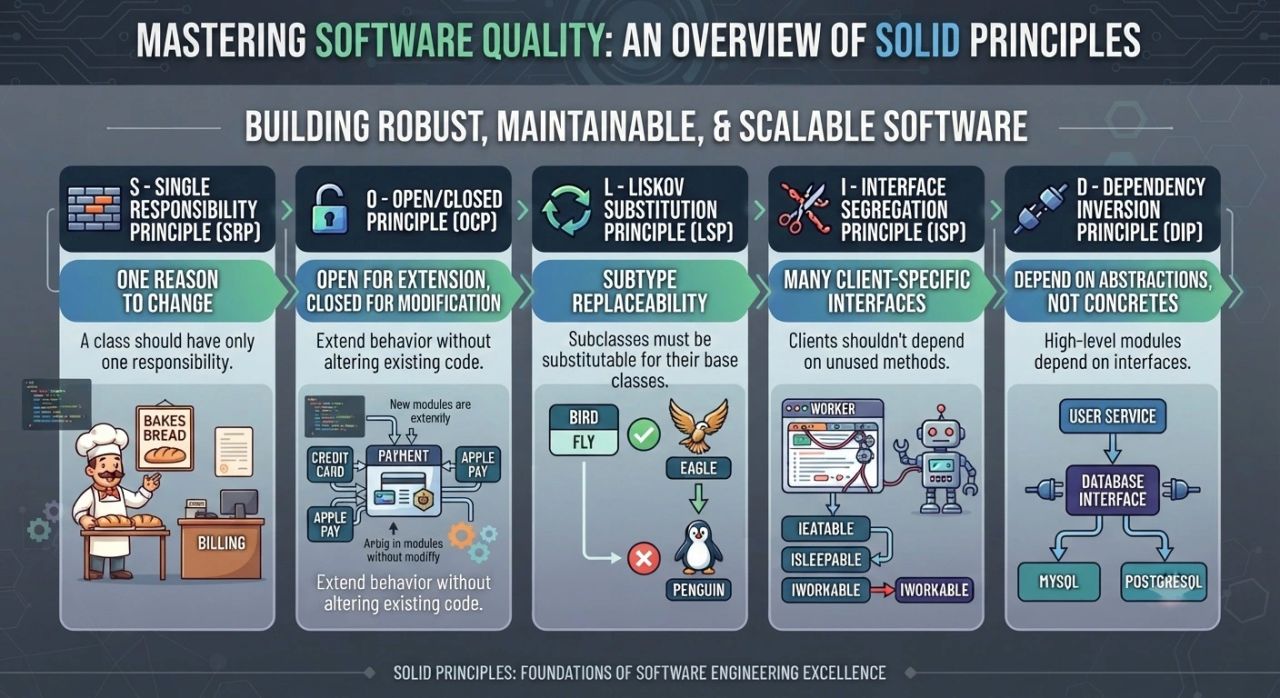
In the rapidly evolving world of software engineering, simply writing code that functions is just the beginning. True engineering excellence lies in designing software that is maintainable, scalable, and easy to extend. As you progress in your career, focusing on Core Fundamentals — rather than just learning the latest frameworks is what distinguishes a great engineer. The SOLID principles are essential guidelines that help developers build flexible, long-lasting software systems that remain understandable and adaptable, even as they grow.
The SOLID Principles Explained
🧱 S – Single Responsibility Principle (SRP) A class should have only one reason to change, meaning it should focus on a single responsibility. Example: Instead of overloading a UserService to handle user creation and email notifications, it is better design to delegate email tasks to a dedicated EmailService. Think of a baker 🥯: their primary job is to bake bread, not to handle billing and delivery 🚚 as well.
🔓 O – Open/Closed Principle (OCP) Software entities should be open for extension but closed for modification. Example: When adding a new feature, such as a new payment method like Apple Pay, you should not need to modify existing, stable code (e.g., adding more if-else blocks). Instead, design your system using interfaces that allow you to extend functionality without altering the original, tested logic.
🔄 L – Liskov Substitution Principle (LSP) Objects of a superclass should be replaceable with objects of its subclasses without breaking the application's behavior. Example: Not every bird 🐦 can fly. Therefore, forcing a Penguin 🐧 class to inherit from a Bird class that includes a fly() method is a design flaw. Subclasses should adhere to the expected behaviors of their parent classes.
✂️ I – Interface Segregation Principle (ISP) Clients should not be forced to depend on methods they do not use. Example: If you have a robot, it does not need to implement Eat() or Sleep() methods. Instead of one massive Worker interface, it is better to design smaller, specific interfaces that provide only the necessary functionality for the client.
🔌 D – Dependency Inversion Principle (DIP) High-level modules should depend on abstractions, not on concrete implementations. Example:Rather than a UserService depending directly on a MySQLDatabase implementation, it should interact through a Database interface. This allows you to easily switch to a different database like PostgreSQL without needing to rewrite your core service logic.
#SOLID #SoftwareEngineering #Java
Sign in to like and join the discussion.